

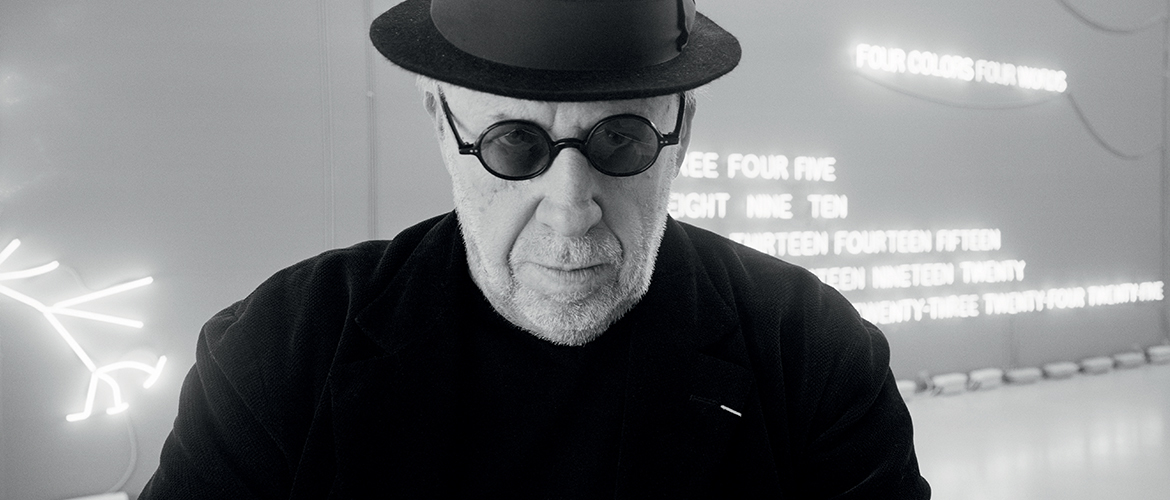
Courtesy Timothy Mason
Joseph KOSUTH
Born in 1945, ihe lives and works in Roma.
Joseph Kosuth is one of the founding fathers of Conceptual Art and of the Art & Language movement, which emerged in the 1960s. The words and concepts expressed in Kosuth’ sentences, transform writing into a subject of reflection and into visual material upon which the viewer can mentally construct a story. What the work of art says is transformed by what it shows.
Through his use of neon, Kosuth creates a concept and, simultaneously, presents its materiality, although the two are independent in his mind: the work resides in the artistic process conceived before its materialization. It consists in a descriptive certificate of the phrase, but does not necessarily involve its materialization in the physical form of a neon sign, which one can choose to realize or not.
In his youth Kosuth was deeply influenced by the thinking of philosopher, mathematician and architect Ludwig Wittgenstein(1889 – 1951). According to Wittgenstein’s theory on colors, the colors are an opportunity to analyze the relationships between logic and experience, truth and falsehood in different linguistic contexts.
Born in Toledo, Ohio, Kosuth studied at the Cleveland Institute of Art, the School of Visual Arts in New York, and the New School for Social Research. He taught for many years in New York, then in Hamburg, Stuttgart, Munich, and Venice. His works are part of the collections of numerous museums, including MoMA, the Guggenheim and Whitney (NY), Tate Modern (London), the Centre Pompidou (Paris), and the Stedelijk Museum (Amsterdam), and he has exhibited at seven editions of Documenta(s) and fourteen Venice Biennales.
Artwork
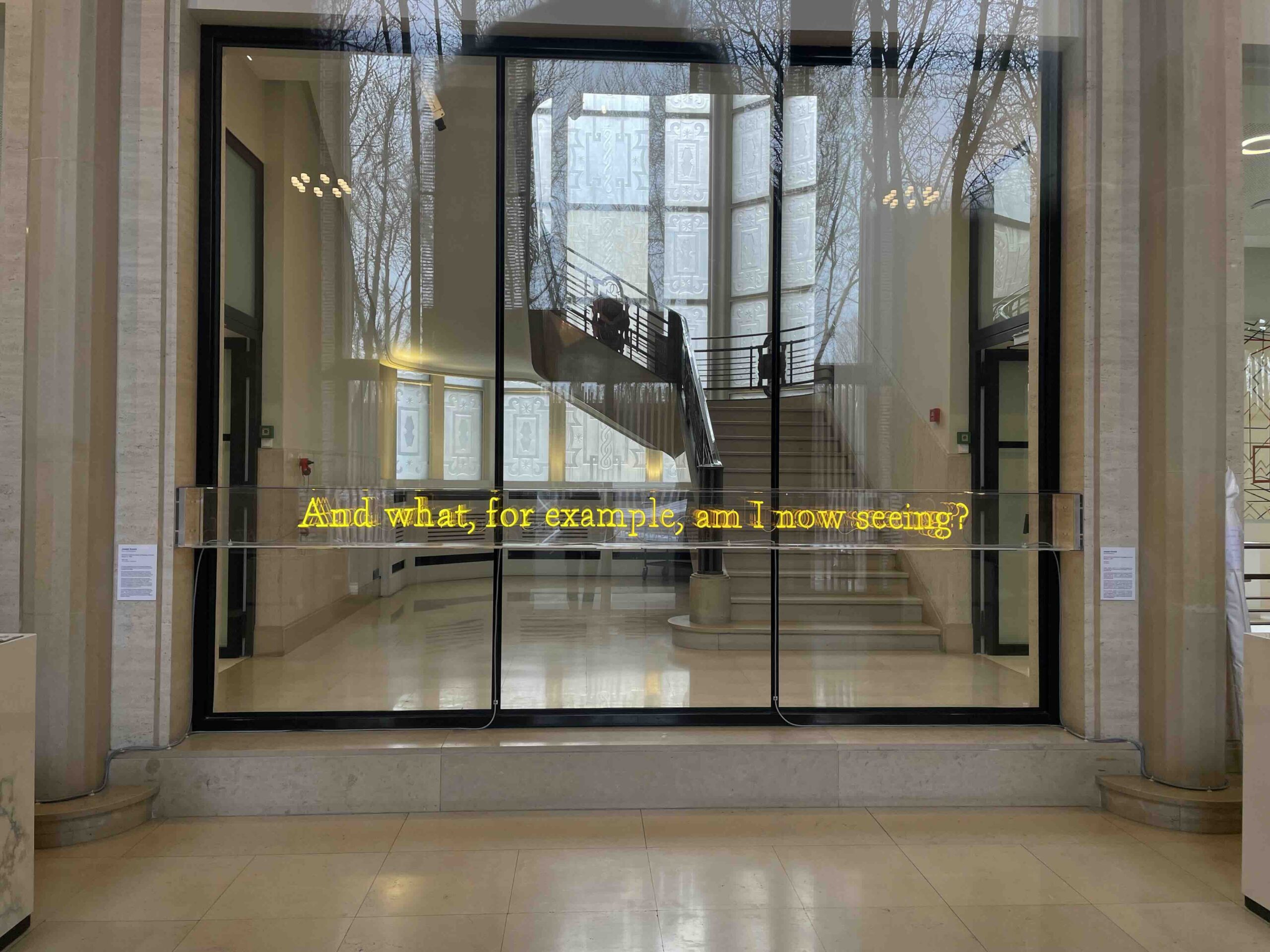
#316 (On Color) (And what, for example, am I now seeing ?) - Joseph Kosuth, 1991
Yellow Neon
7.5 x 131.9 in. / 19 x 335 cm
Discover the artwork